
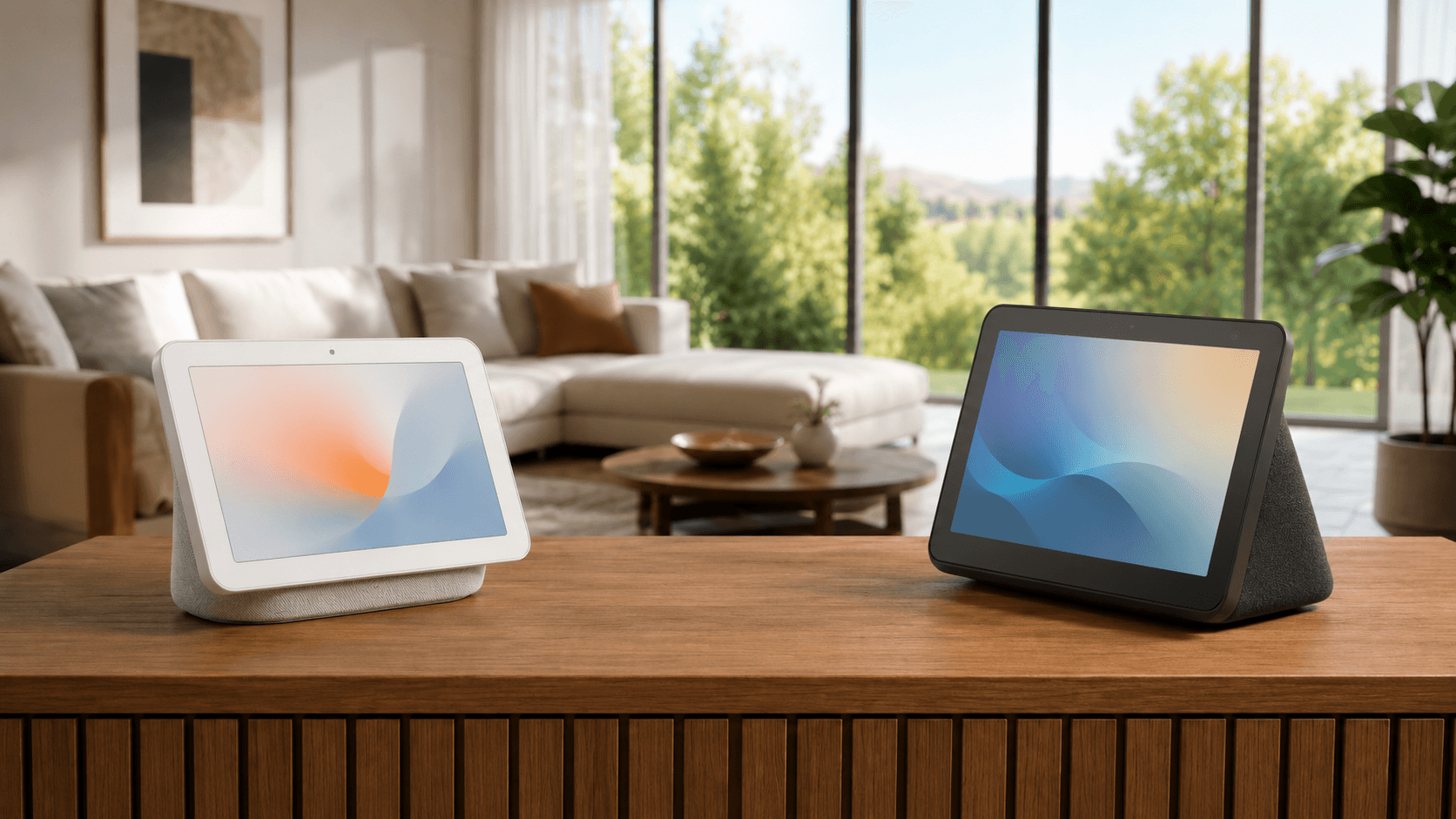
When embarking on the journey to make a home “smart,” the debate almost invariably settles into a polite duel between two tech giants: Google Home or Amazon Alexa?
The short, slightly inconvenient answer is: neither.
While smart speakers are perfectly respectable additions to the modern household, mistaking a voice assistant for a proper smart home hub is a bit like appointing the town crier as the head of civil infrastructure.
The Interface vs. The Intellect
Voice assistants—whether Google, Alexa, or Siri—are front-end interfaces. They are digital megaphones designed to broadcast music, check tomorrow’s rain forecast, and mishear a shopping list.
A true smart home hub, by contrast, is the quiet operating system running behind the scenes. When you rely on a smart speaker to orchestrate your house, every switch toggle and sensor trigger must embark on an international voyage to a remote server farm and back just to turn on a lamp three feet away.
Should your broadband connection suffer a brief spell of lethargy, the entire illusion evaporates. You are left standing in a dark corridor, negotiating politely with an unresponsive plastic puck.
What a Dedicated Hub Actually Does
A well-engineered home requires a dedicated local controller that runs independently of the wider internet:
Local Speed & Reliability: Automations process locally on hardware inside your walls. Motion sensors trigger lights in milliseconds, entirely indifferent to whether your broadband is working or having a lie-down.
Genuine Automation Logic: Big-tech assistants offer elementary "if this, then that" routines. A dedicated hub effortlessly juggles nuanced conditions—such as tailoring hallway brightness to the ambient light, the time of night, and whether the house is in "guest mode."
Sensible Privacy: Your movements, sensor logs, and domestic routines remain your private business, safely contained within your local network rather than catalogued for targeted advertising.
The Civilised Compromise
This isn't to say voice assistants should be banished. Barking orders at a speaker to play a podcast or announce dinner remains thoroughly convenient.
The most reliable homes simply use a dedicated, local-first platform to handle the heavy lifting, treating Google, Siri, or Alexa purely as the voice layer on top. You get the everyday convenience of voice control, without trusting the reliability of your entire home to a server across the ocean.
Curious how much faster and more reliable your setup would be with a dedicated local controller running the show behind the scenes? Book a free consultation.